





Iconic Address Series: The Kennedy Homes That Still Define Washington
Few families are tied to Washington real estate quite like the Kennedys. Long before the current era of influencers and curated Instagram tours, the Kennedy family transformed their private residences into a piece of the American story itself. Thanks in part to renewed fascination sparked by Ryan Murphy’s Love Story series and the digital landscape’s ensuing obsession with all things “Camelot”, the addresses tied to this political dynasty are having their moment yet again. It’s because of this resurgence (matched only by the family’s enduring legacy) that we’ve decided to revisit the homes that have helped shape the mythology surrounding the Kennedys against the backdrop of the city they once called home. From storied Georgetown rowhouses to sprawling estates tucked into the Virginia countryside, these residences stand as some of the most recognizable and talked-about properties across the DMV still today.
Here’s an inside look at a few of the Kennedy family’s most iconic addresses…and why they continue to capture Washington’s (and the world’s) imagination decades later.
Hickory Hill: The Original Kennedy Compound Outside the City
Located in McLean, Hickory Hill occupies a singular place in Kennedy history, though the property’s ties to the family actually began before Robert and Ethel Kennedy made it famous. The estate was originally purchased by John F. Kennedy and Jacqueline Kennedy Onassis in 1955, during JFK’s years as a US Senator from Massachusetts. At the time, the couple was searching for a retreat outside the city that still allowed easy access to Washington political life. Set high above the Potomac River on a substantial tract of land in McLean, Hickory Hill offered exactly that: privacy, scale, and proximity to the capital without the formality of Georgetown society. JFK and Jackie reportedly invested heavily in renovations and expansions during their ownership, transforming the already historic property into a more substantial family estate. Yet despite purchasing the home, the couple never spent extensive time there. As JFK’s national political ambitions accelerated and the demands of public life intensified, the estate increasingly became associated with his younger brother, Robert F. Kennedy, and RFK’s wife, Ethel Kennedy. In 1957, JFK sold Hickory Hill to the couple, beginning the chapter that would ultimately cement the property’s reputation.
Under RFK (who would become US Attorney General and Senator) and Ethel, Hickory Hill evolved into something far larger than a private residence. With eleven children, constant visitors, political allies drifting in and out, and gatherings that ranged from touch football games to late-night strategy sessions, the estate became the emotional center of the extended Kennedy orbit. If the White House symbolized the polished public image of Camelot, Hickory Hill represented the family behind the scenes: loud, competitive, chaotic, intellectual, glamorous, and deeply intertwined. Diplomats, journalists, Hollywood figures, civil rights leaders, and political operatives all reportedly passed through its doors during the 1960s.
For more reasons to delve into the architecture that defines DC, read our post: Architecture in DC: From Historic Beginnings to Modern Marvels.
3321 Dent Place NW: JFK and Jackie’s First Newlywed Home in Washington
Before the White House and before the Marbury House, John F. Kennedy and Jacqueline Kennedy began their married life at 3321 Dent Place NW. The couple rented the Georgetown townhouse shortly after their 1953 wedding, during JFK’s early years as a senator from Massachusetts. More elegantly intimate than overtly grand, the home marked the launch of their Washington life together and placed them in the neighborhood that would become inseparable from the Kennedy mystique from that day on.
The Marbury House: The Georgetown Home of a Rising President
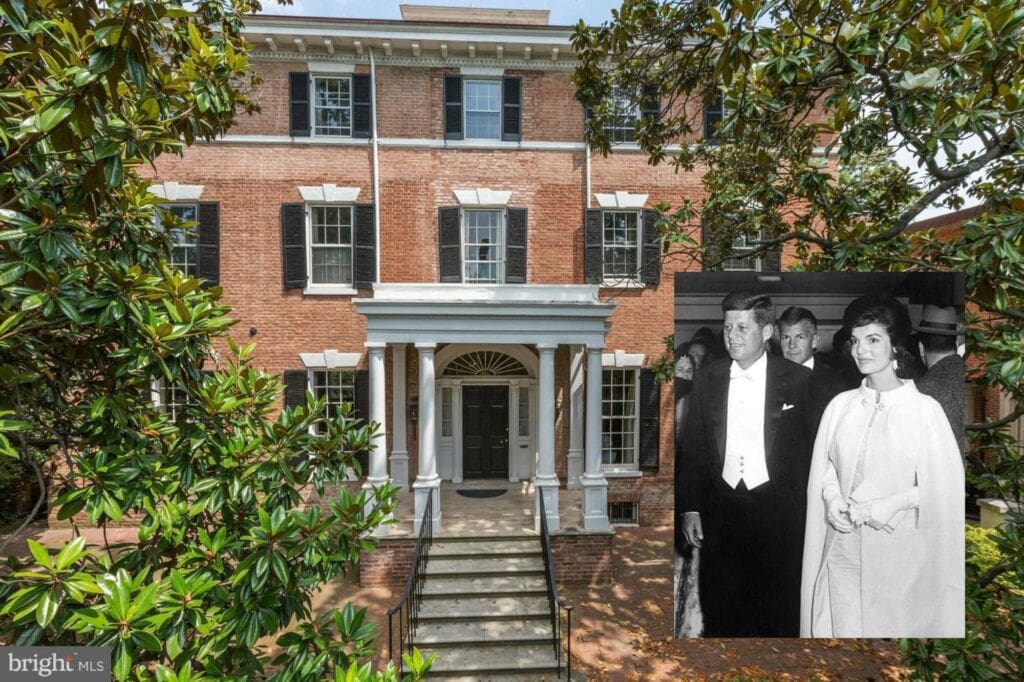
In 1957, the Kennedys purchased the Marbury House at 3307 N Street NW, one of Georgetown’s most historically significant residences. Originally commissioned in the early 19th century by William Marbury, whose landmark Supreme Court case Marbury v. Madison helped establish the principle of judicial review, the Federal-style home already occupied a notable place in Washington history even before the Kennedys arrived. Defined by its balanced proportions, understated elegance, and classic Georgetown façade, the residence reflected the refined architectural traditions that continue to embody the neighborhood today. For JFK and Jackie, however, the home became something far more personal: a stage for young family life, rising political ambition, and the carefully cultivated Georgetown world that helped shape the Kennedy image in the years leading up to the 1960 presidential campaign. Jackie reportedly took a particular interest in the interiors and entertaining spaces, transforming the residence into a polished setting for intimate gatherings, political conversations, and salon-style hosting. During the campaign years, the townhouse evolved into an informal center of activity as advisors, journalists, and political figures circulated through its rooms before the family ultimately departed for the White House in 1961.
3017 N Street NW: Jackie Kennedy’s Return to Georgetown After the Assassination
After President Kennedy’s assassination in 1963, Jacqueline Kennedy returned to Georgetown, eventually purchasing 3017 N Street NW, the historic Newton D. Baker House. Built in the late 18th century and later owned by Newton D. Baker, Woodrow Wilson’s secretary of war, the residence offered history, stature, and a longed-for sense of refuge. But life there quickly proved impossible under the weight of public attention. Crowds, photographers, and tour buses gathered outside, turning what was meant to be a private home for Jackie, Caroline, and John Jr. into just another stage of national mourning. In 1964, she left Washington for New York, effectively ending the Kennedy family’s Georgetown chapter for good.
For more distinct DC flavor, be sure to check out our:
Merrywood: Jackie Kennedy’s Formative Virginia Estate
Long before Jacqueline Kennedy became one of the most recognizable women in the world, she spent much of her youth at Merrywood, the storied Georgian Revival estate overlooking the Potomac River in McLean, Virginia. Built in 1919 and surrounded by formal gardens designed by illustrious landscape architect Beatrix Farrand, the estate stood as one of Jackie’s primary family homes after her mother married Hugh D. Auchincloss Jr. in 1942. Unlike the political symbolism attached to the Georgetown and White House years, Merrywood represented something more innocent and personal: horseback riding, summers along the Potomac, private family life, and the East Coast world that helped shape Jackie’s lifelong aesthetic sensibilities. She later wrote fondly about the property’s landscape and peaceful river setting. The home itself carried extraordinary social and architectural pedigree. Over the decades, Merrywood grew to be associated not only with Jackie Kennedy herself, but with Washington society, media dynasties, and some of the region’s most prominent cultural figures. Even today, the estate remains one of the Washington area’s most iconic private residences: a property whose legacy extends beyond celebrity into the broader folklore of American aristocratic style.
Why Kennedy Homes Continue to Fascinate Buyers and Locals
Washington has no shortage of famous addresses, but the Kennedy properties occupy a category entirely their own. Part of the allure is architectural, since many of these homes are undeniably beautiful, historically significant residences located in some of the region’s most prestigious enclaves. More than that, though, they tell a story people still care to revisit to this day.
The Kennedy era represented a rare convergence of politics, celebrity, wealth, style, tragedy, and hope…and the homes connected to the family became physical symbols for all of it. Even today, listings tied to the Kennedys tend to generate outsized attention, whether they hit the market publicly or quietly trade hands behind the scenes. And in a city built on legacy, few names still carry quite the same weight.
Ready to connect with a team whose expertise spans everything from historical properties to modern marvels? Get started by filling out the form on this page, calling us at 202.280.2060, or emailing connect@jennsmira.com.

Put Us To Work For You
Book a consultation with our team today.